Aziz liked to hear his religion praised. It soothed the surface of his mind, and allowed beautiful images to form beneath. When the engineer’s noisy tirade was finished, he said. “That is exactly my own view.” He held up his hand, palm outward, his eyes began to glow, his heart to fill with tenderness. Issuing still farther from his quilt, he recited a poem by Ghalib. It had no connection with anything that had gone on before, but it came from his heart and spoke to theirs. They were overwhelmed by its pathos; pathos, they agreed, is the higher quality in art; a poem should touch the hearer with a sense of his own weakness, and should institute some comparison between mankind and flowers. The squalid bedroom grew quiet; the silly intrigues, the gossip, the shallow discontent were stilled, while words accepted as immortal filled the indifferent air. Not as a call to battle, but as a calm assurance came the feeling that India was one; Moslem; always had been; an assurance that lasted until they looked out of the door. Whatever Ghalib had felt, he had lived in India, and this consolidated it for them: he had gone with his tulips and roses, but tulips and roses do not go. And the sister kingdoms of the north–Arabia, Persia, Ferghana, Turkestan–stretched out their hand as he sang, sadly, because all beauty is sad, and greeted ridiculous Chandrapore, where every street and house was divided against itself, and told her that she was a continent and a unity.
Of the company, only Hamidullah had any comprehension of poetry. The minds of the others were inferior and rough. Yet they listened with pleasure, because literature had not been divorced from their civilization. The police inspector, for instance, did not feel Aziz had degraded himself by reciting, nor break into the cheery guffaw with which an Englishman averts the infection of beauty. He just sat with his mind empty, and when his thoughts, which were mainly ignoble, flowed back into it they had a pleasant freshness. The poem had done no “good” to anyone, but it was a passing reminder, a breath from the divine lips of beauty, a nightingale between two worlds of dust. Less explicit than the call to Krishna, it voiced our loneliness nevertheless, our isolation, our need for the Friend who never comes yet is not entirely disproved.


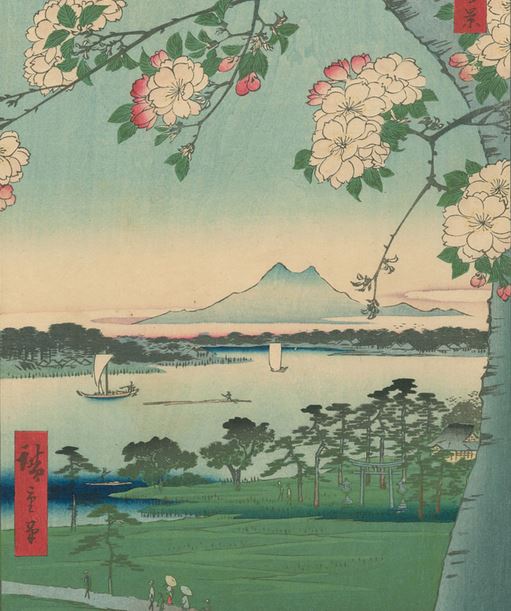 Detail – 100 Views of Edo, #35, by Hiroshige (image from